
For a jewelry brand buying pouches in volume, the closure changes more than the look. It affects how staff place a piece inside, how a customer opens it, and how consistently the pouch presents the jewelry. A drawstring pouch and a snap-flap pouch can both work for retail packaging, but they solve different handling problems. This guide gives buyers a practical way to compare them before approving a bulk order.
Start with the jewelry and the handoff
List the pieces that will go into the pouch: rings, earrings, bracelets, necklaces, or a mixed assortment. Then describe the actual handoff. Will store staff pack each order at a counter? Will the pouch sit inside a rigid box? Will customers reopen it for storage? A closure should be tested in that setting, with the intended jewelry inside, rather than judged from an empty sample.
How the two closures compare
| Buying question | Drawstring pouch | Snap-flap pouch |
|---|---|---|
| Opening action | Pull both cords to close; loosen the opening to retrieve the piece. | Lift the flap and release the snap. |
| Presentation | Soft, gathered top suited to a simple handoff or secondary packaging. | Flat front and defined flap can create a more structured reveal. |
| Fit check | Check usable opening and whether the cords close around the packed piece. | Check flap alignment, snap position, and whether the packed piece distorts the closure. |
| Sample handling | Repeat opening and closing; inspect cord movement and seams. | Repeat snap cycles; inspect alignment, flap edges, and any insert fit. |
These are comparison points, not claims that one style protects jewelry better. Protection depends on the complete package, the piece, and any insert or outer box.

When a drawstring pouch makes sense
A drawstring pouch is useful when a brand wants a soft package that can be opened and closed without a rigid flap. For a counter handoff, test whether staff can place the jewelry inside without catching a chain or earring post. For a boxed set, measure the pouch after filling it: the gathered top can add height. Review this drawstring pouch example for the visual format, then request a physical sample for the exact product.
When a snap-flap pouch makes sense
A snap-flap format may suit a planned reveal where the front stays relatively flat. Test it with the largest piece in the range. The flap should reach the snap without forcing the jewelry or insert out of position. Check whether repeated opening leaves the flap aligned and whether the jewelry can be removed without scraping against the closure.
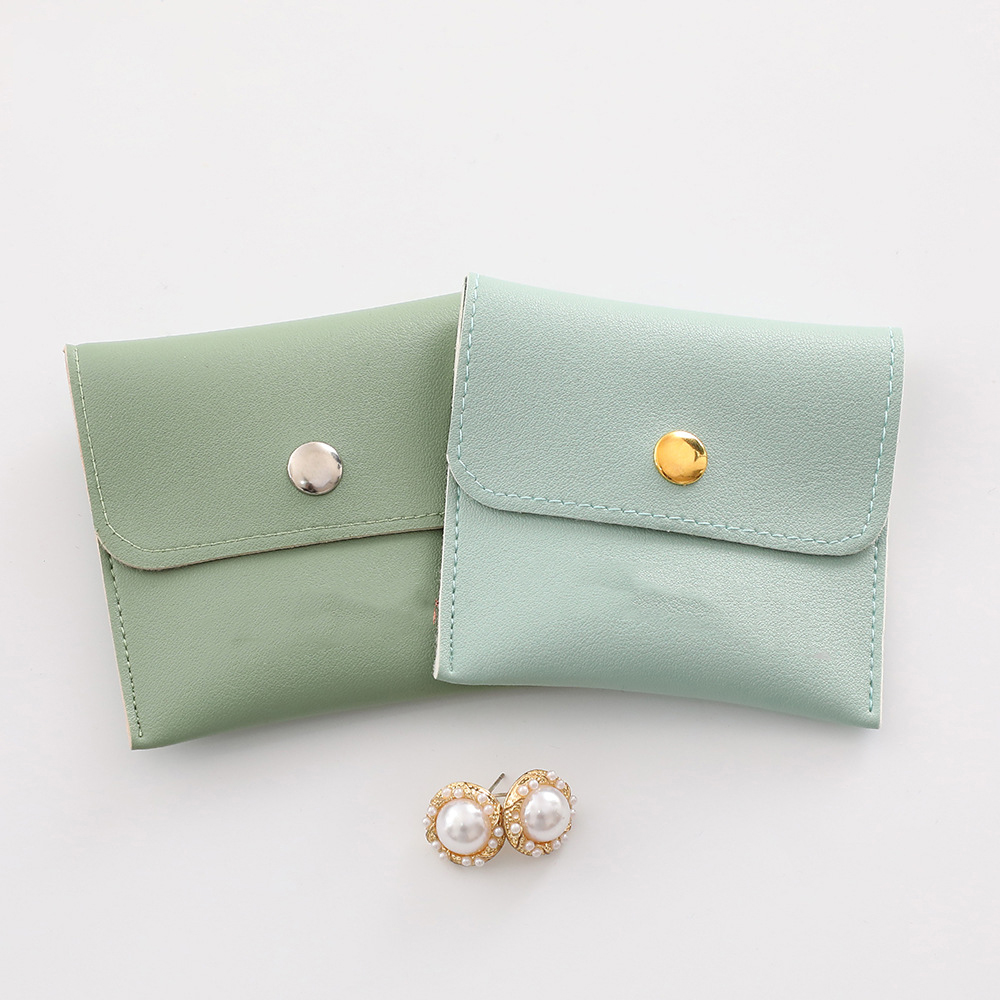
The envelope-style pouch example shows this visual direction. Confirm the intended insert and jewelry fit on a sample; a photograph cannot establish the internal dimensions.
A sample approval checklist for bulk buyers
- Provide the actual jewelry or dimensional drawings and specify whether the pouch is primary or secondary packaging.
- Ask for the usable internal space, opening width, and filled external dimensions for each size under consideration.
- Pack and remove every jewelry type in the assortment, including the largest or most delicate piece.
- Open and close several samples repeatedly; inspect stitching, cords or snap alignment, edges, and the appearance after handling.
- Compare the approved sample against the proposed logo position, color reference, and any outer box or display tray.
- Record the accepted sample and inspection points before a production order.
If one pouch is meant to serve several products, do not assume the smallest sample that fits one ring will also work for a bracelet or necklace. Request a size matrix tied to specific jewelry types and test representative pieces.
Frequently asked questions
Is a drawstring pouch suitable for necklaces?
It can be, but test the chain during insertion and removal. If tangling matters, evaluate an appropriate card, insert, or other restraint with the actual necklace.
Does a snap-flap pouch need an insert?
That depends on the piece and the desired presentation. Ask the supplier to show the exact interior configuration and test whether it holds the jewelry in place when the pouch is moved.
Can the same closure work for a full collection?
Possibly, but use a sample of each proposed size and test the largest and smallest pieces. Specify which size belongs to each SKU instead of approving the closure style alone.
Plan the next sample
Send JERL the jewelry types, approximate dimensions, intended sales channel, preferred closure, color reference, and branding artwork. We can discuss customization options and help you compare pouch samples before you decide on a packaging format. Contact us with your packing brief.


